A good travel yoga mat is the lightest, thinnest option that still works for the way you practice and the way you pack. Start with the trip: choose a mat explicitly designed to fold if it must fit inside a suitcase or backpack, then compare its actual weight, thickness, dimensions, surface, and storage instructions. A travel mat is a deliberate tradeoff, not simply a smaller version of a home mat.
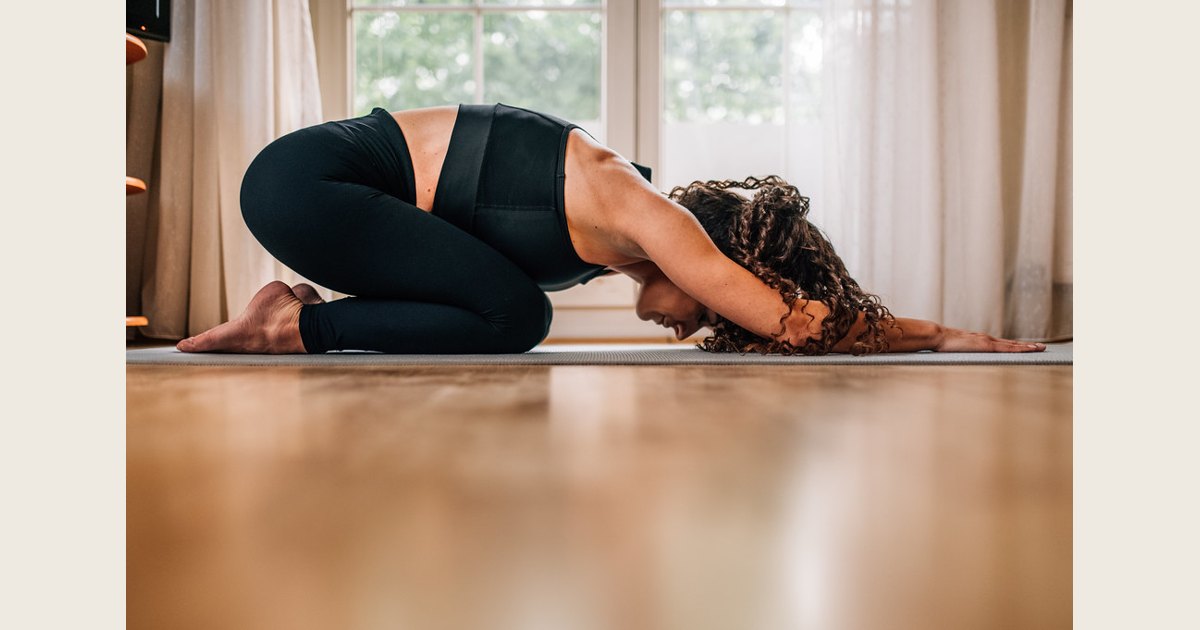
Featured image credit: Photo: Extended puppy pose on yoga mat. A young woman stretching by Ivan Radic, https://www.flickr.com/photos/26344495@N05/51287191909; https://creativecommons.org/licenses/by/2.0/. Resized and padded. Illustrative stock photo; no product testing is implied.
Editorial note
This guide compares published manufacturer specifications and care directions. Rep and Routine did not test these mats. A maker’s description can help you compare features, but it cannot predict fit, grip, or comfort for an individual practice.
Key takeaways
- Choose packability first: a mat that can be folded is more practical for a suitcase than one that only works as a bulky roll.
- Read weight and thickness together. Less material may make packing easier, but it also means less cushioning between you and the floor.
- Treat grip as a practice-specific question. Consider whether your hands get sweaty, whether you practice in heat, and whether you need a towel.
- Check the product’s material and care directions before buying. They affect sensitivity considerations, cleaning, and whether the mat should be stored rolled or folded.
- Measure your available space rather than relying on labels such as “travel” or “lightweight.”
Start with how the mat has to travel
A travel yoga mat needs to fit your transportation, not just your practice. If it will live inside a carry-on, backpack, or checked suitcase, prioritize a product whose maker explicitly says it folds. The official pages for two thin travel models describe them as foldable; one also says it fits a tote, backpack, or carry-on (GRP Adapt Travel; PRO Travel). JadeYoga similarly says its Voyager Mat folds to about yoga-block size for a suitcase or backpack. That language is more useful than assuming any thin mat can tolerate repeated creasing.
| If your main priority is… | Start by looking for… | Check before you buy |
|---|---|---|
| Packing inside luggage | A mat described as foldable and packable | Its folded shape, stated storage directions, and your bag dimensions |
| Carrying the mat separately | A rollable mat or a mat with a compatible carrier | The rolled size and whether a separate carry item suits the trip |
| Practicing on a hotel floor or shared surface | A mat the maker says can be layered over carpet or another mat | Whether you want a standalone practice surface or a topper |
| Keeping the load down | A listed weight that fits your packing limit | The tradeoff in thickness and usable width |
There is an important difference between folding for transit and storing folded. For example, the PRO Travel is marketed as foldable for packing, but its care directions say to roll it with the practice surface facing out and not to store it folded. JadeYoga likewise advises rolling its Voyager when not traveling to minimize folding creases. Follow the instructions for the specific model rather than leaving a folded mat in a drawer between trips (PRO Travel care guidance; Voyager storage guidance).
Choose thickness and weight as a pair
Do not select a travel yoga mat by thickness alone. A thin profile can be easier to pack, but your practice still happens on whatever is underneath it. Look at the surface where you expect to practice: hard flooring, hotel carpet, a studio rental mat, or another mat you already own.
Product specifications make the compromise concrete. Manduka lists its GRP Adapt Travel at 1.5 mm and 2 lb (1 kg), with a 71-by-26-inch practice area. Its PRO Travel is 2 mm and 2.9 lb (1.3 kg) in the standard 71-by-24-inch version. JadeYoga lists its 68-by-24-inch Voyager at 1/16 inch thick and just over 1.5 lb (Voyager specifications). These are examples of specific designs—not universal rules—but they show why “only a little thicker” can also mean a meaningful change in packed weight and width. Read the listed specifications for every size, because a long version can weigh more (GRP Adapt Travel specs; PRO Travel specs).
For a short trip where the mat is mostly a barrier over carpet or a studio mat, minimal thickness may be a sensible compromise. If you regularly want more cushioning on hard floors, it may be more realistic to travel with a thin mat and use an available surface underneath it—or choose a fuller mat for trips where luggage is less constrained. For context on that tradeoff at home, see our thick yoga mat buying guide.
Make grip a practice-specific decision
“Grippy” does not mean the same thing for every practice. Think about your usual conditions: a calm, dry practice in a guest room calls for a different surface than a heated class or a session where your hands and feet get sweaty. Then read what the maker says about the top surface, moisture, and use with towels.
For instance, Manduka says the GRP Adapt Travel’s polyurethane-and-latex-rubber surface absorbs moisture and is intended for use in sweaty sessions. Its PRO Travel page takes a different approach: it notes that the closed-cell surface may feel slick for people prone to sweating and suggests pairing it with a towel for grip. These are manufacturer statements about those particular products, not proof that one material will suit every person. They do, however, give you useful questions to ask before checkout: Does the surface handle your typical moisture level? Is a mat towel practical in your packing plan? Does the bottom stay put on the floors you expect to use? (GRP Adapt Travel; PRO Travel care guidance)
Illustrative yoga-practice image; it does not show or test a travel yoga mat.
Photo: Fit woman doing a plank on yoga mat by Ivan Radic, https://www.flickr.com/photos/26344495@N05/51293161090; https://creativecommons.org/licenses/by/2.0/. Resized and padded. Illustrative stock photo; no product testing is implied.
Compare materials and care requirements before packing
Material labels are not marketing trivia. They tell you what to investigate for sensitivity, cleaning, and storage. In the examples above, the GRP Adapt Travel is listed as polyurethane/latex rubber and is not recommended by its maker for people with latex sensitivities. The PRO Travel is listed as PVC and latex-free. Neither description makes a material automatically right or wrong; use it to narrow the field based on your needs and the product’s instructions.
Care directions deserve the same attention as the spec table. The GRP Adapt Travel directions say to let the mat dry fully before storing and not to soak it, use soap, or use harsh chemicals. The PRO Travel directions call for warm water or the maker’s specified cleaner, wiping it dry before rolling, and storing it cool and dry. These instructions differ by product, so do not transfer a cleaning routine from one mat to another. Our guide to cleaning a yoga mat by material can help you frame the questions to ask, but the manufacturer’s directions for your exact mat come first.
Use this five-minute shopping check
Before choosing, open the specifications and answer these questions in order:
- Where will it go? Confirm the folded or rolled format works with your suitcase, personal item, or day bag.
- What surface will be underneath? Hard flooring, carpet, and a shared studio mat create different cushioning and stability needs.
- What is the actual listed weight? Compare it with the rest of your packed load, not with another mat’s marketing label.
- What happens when you sweat? Read the surface description and towel guidance rather than assuming a texture will work in every class.
- How must it be stored and cleaned? A mat that is easy to take on a trip can still be inconvenient if it must be dried, rolled, or cleaned in a way you cannot manage while traveling.
Also check the return policy, because grip, width, and the feel of a thin mat are personal preferences that a product page cannot settle for you.
When a travel mat is not the best one-mat solution
A travel mat is not automatically the right purchase just because you travel. If you primarily drive to classes, have ample trunk space, or want substantial cushioning every time you practice, a regular mat may be the simpler choice. You can still travel with it occasionally, even if it is less compact.
Likewise, do not expect a thin travel design to replace every specialized setup. A mat intended as a lightweight personal layer may work well over carpet or a rental mat, while a hard-floor practice may call for a different compromise. Decide which situation matters most on this trip instead of trying to optimize every scenario with one product.
Travel yoga mat FAQ
Can I fold any yoga mat?
No. Only fold a mat when its maker permits it. A travel model can be described as foldable for packing yet still need to be stored rolled afterward, so check both the travel and storage directions.
Do I need a yoga towel with a travel mat?
Not automatically. It depends on the mat and your practice conditions. One travel-mat maker says its moisture-absorbing surface is designed for sweaty sessions without an additional towel, while another recommends a towel for people whose sweat makes its closed-cell surface feel slick. Plan around the directions for the exact mat you choose.
Is a travel yoga mat durable enough for everyday use?
Durability is model-specific, so look for the maker’s construction description, guarantee, care instructions, and storage limits rather than treating “travel” as a durability rating. If everyday use is the main goal, compare it directly with a standard mat before deciding.