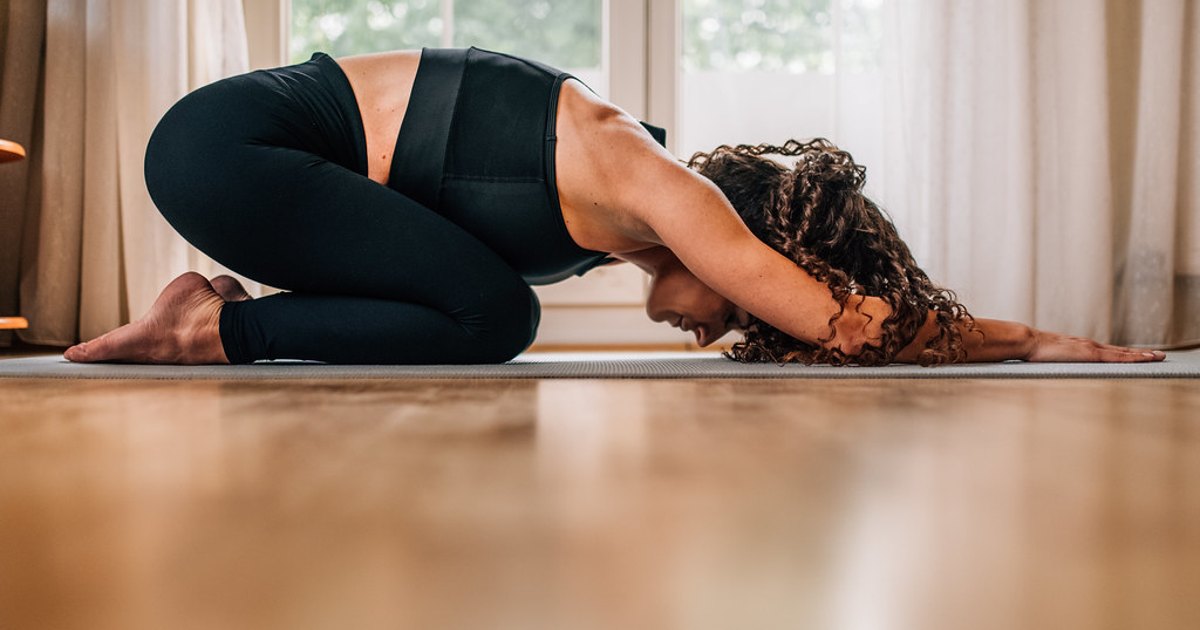
A thick yoga mat is worth it when your practice spends a lot of time on your knees, wrists, hips, or spine, and it works against you when your practice is built on standing and balancing. Extra padding protects your joints in kneeling and floor work, but the same softness makes it harder to feel the floor and stay steady in poses like Tree. There is no single “best” thickness. The right choice depends on your style of yoga, the surface you practice on, your body, and how far you carry the mat.
Key Takeaways
- Standard mats are about 1/8 inch (roughly 3 mm) thick; “thick” mats run to about 1/4 inch (roughly 6 mm); travel mats are about 1/16 inch (roughly 1.5 mm) (Gaiam).
- Thicker mats cushion joints but reduce your connection to the floor, which can make you wobblier in balance poses (Gaiam).
- Material and density matter as much as thickness: a dense mat can feel more supportive than a thicker but softer one.
- The knee and lower leg are the body parts most commonly injured in yoga, so cushioning where you kneel is a reasonable priority (NCCIH).
- Many people do not need a thick mat at all. If you rarely kneel and value steadiness, a standard mat may serve you better.
What Counts as a “Thick” Yoga Mat?
Thickness is usually described in inches or millimeters, and the range is narrower than it sounds. A standard mat is about 1/8 inch, or roughly 3 mm. The mats most retailers label “thick,” “premium,” or “extra cushion” are about 1/4 inch, or roughly 6 mm. At the other end, wafer-thin travel mats are about 1/16 inch, close to 1.5 mm, and are built to fold into a suitcase rather than to pad your joints (Gaiam).
So when people say “thick yoga mat,” they usually mean something in the 6 mm range, sometimes up to 8 mm or more in specialty and fitness mats. The jump from 3 mm to 6 mm doubles the cushion but only adds a few millimeters, which is why the choice feels small on paper and large under your knee.
The Core Trade-Off: Cushioning Versus Stability
The single most important thing to understand is that cushioning and stability pull in opposite directions.
A thicker mat gives your joints more to sink into. That helps in any pose where a bony part of your body presses into the floor: kneeling lunges, tabletop, hero pose, seated forward folds, and long stretches on your back or side. If a thin mat leaves your kneecap aching during a lunge, more padding is the direct fix (Gaiam).
The same softness is a liability when you need a stable base. In standing balance poses, your foot needs to feel the ground and make small corrections. A thick, cushioned mat muffles that feedback and lets your foot rock slightly, so poses like Tree can feel wobblier than they would on a firmer surface (Gaiam). Balance is a skill yoga can genuinely build, and it is worth protecting your ability to practice it (NCCIH).
In short: pick more thickness for the joints you kneel and lie on, and less thickness for the feet you balance on. Your practice tells you which one matters more.
Thickness Is Only Half the Story: Material and Density
Thickness measures how tall the mat is. Density measures how firm it is. Two mats of the same thickness can feel completely different depending on what they are made of and how tightly that material is packed.
Material determines “sponginess,” or how much the mat yields to pressure. Among common materials, PVC generally has the most give, while jute and cotton have the least; natural and recycled rubber fall in between and vary widely by blend (Gaiam). This is why a dense rubber mat at a modest thickness can feel more supportive and stable than a thicker but softer foam or TPE mat that compresses fully the moment you put weight on it.
The practical takeaway: do not shop on the millimeter number alone. A firm, dense 4 mm mat may give you a better mix of joint support and steadiness than a plush 8 mm mat that bottoms out. If you can, press your hand or knee into a mat before buying and notice whether it supports you or simply flattens.
Match Thickness to Your Practice Style
Use the table below as a starting point, then adjust for your own body and floor.
| Your practice | Suggested thickness | Why |
|---|---|---|
| Standing, balance, flowing vinyasa | Standard, ~3 mm (up to ~4-5 mm dense) | Stability and floor feel matter more than padding |
| Mixed hatha or general classes | ~4-5 mm | A middle ground between cushion and connection |
| Restorative, yin, floor-heavy, knee-sensitive | Thick, ~6 mm and up | Long holds on joints reward extra cushioning |
| Travel and studio commuting | ~1.5 mm travel, or standard | Weight and packability come first |
These are guidelines, not rules. A vinyasa practitioner with cranky knees might choose a firm 5 mm mat and simply fold it or add a blanket under the knees for kneeling work. A restorative practitioner who also does standing poses might keep a thick mat for the floor and step onto a firmer surface for balance.
Your Floor Changes the Answer
The surface under your mat matters almost as much as the mat itself.
On a hard floor, such as wood, tile, or concrete, cushioning does more work, and a thin mat can leave joints unprotected. On carpet, the floor already provides padding, so a thick mat stacked on carpet can feel unstable, like standing on a mattress. If you practice on carpet and feel wobbly, a thinner or denser mat often restores the steadiness you are missing.
If you switch between surfaces, choose for the harder one and accept that balance poses on carpet will take a little more concentration.
Weight, Portability, and Durability
Thickness has costs beyond stability.
Thicker mats are heavier and bulkier. If you carry your mat to a studio, up stairs, or onto public transit, a 6 mm mat is a noticeably bigger load than a standard one, and travel mats are thin specifically so they fold small and weigh little (Gaiam). Be honest about how far and how often you carry it.
Durability depends more on material and construction than on thickness alone. Softer foam mats can compress permanently, dent under knees and elbows, or curl at the edges over time, while denser rubber and PVC mats tend to hold their shape. Whatever you choose, keeping it clean helps it last; if you need a method matched to your mat’s material, see our guide on how to clean a yoga mat.
When You Do NOT Need a Thick Mat
Plenty of people buy more cushion than their practice calls for. You can probably skip the thick mat if:
- Your practice is mostly standing, balancing, or flowing, where a firm base helps.
- You practice on carpet or another already-padded surface.
- You carry your mat often and value light, packable gear.
- Your knees, wrists, and hips feel fine on a standard mat.
A standard 3 mm mat, or a dense 4-5 mm one, covers a large share of general yoga comfortably. Spending more on thickness you do not use can actually make balance poses harder.
When Thickness Genuinely Helps
Reach for a thicker mat if:
- You spend long stretches kneeling, sitting, or lying down, as in restorative or yin yoga.
- Your knees or wrists ache on a thin mat during lunges, tabletop, or planks.
- You practice on a hard floor with no other padding.
- You have joint sensitivity that makes bony contact with the floor uncomfortable.
The knee and lower leg are the body areas most commonly injured in yoga, so protecting the joint you kneel on is a sensible reason to add padding (NCCIH). Cushioning a sore knee is also cheaper and simpler than pushing through discomfort.
Troubleshooting Common Mat Problems
Wobbly in balance poses. If a mat feels unstable, it is likely too thick or too soft for you. Try a thinner or denser mat, or step off the mat onto the bare floor for standing balance work.
Sore knees or wrists. Add cushion where you need it. That can mean a thicker mat, or a folded blanket or mat doubled under the knees and heels of the hands, without committing your whole practice to a soft surface.
Mat slides or bunches. This is usually grip and texture, not thickness. Denser materials and textured surfaces resist sliding; a clean mat also grips better than a dirty one.
Edges curling. Softer, thinner mats and heavily compressed foam are the usual culprits. A denser mat, or storing it rolled with the top surface out, helps it lie flat.
A Note on Safety and Fit
A mat is comfort equipment, not medical equipment. Yoga is generally safe for healthy people when practiced properly under the guidance of a qualified instructor, though sprains and strains can happen, and older adults face a somewhat higher rate of yoga-related injuries treated in emergency departments (NCCIH). No amount of padding replaces good technique or the right pose choices for your body.
If you have a preexisting condition such as a knee or hip injury, lumbar spine disease, balance problems, severe high blood pressure, or glaucoma, talk with your health care provider and your instructor about modifying poses, and do not use yoga to postpone care for a medical problem (NCCIH). As with any new exercise routine, it is reasonable to check with your doctor before you start (Harvard Health). A thicker mat can make a sensible practice more comfortable, but it cannot make an unsafe pose safe.
The Bottom Line
Think of thickness as a dial, not an upgrade. Turn it up for cushion and joint protection; turn it down for stability and floor feel. Then remember that density and material can shift the whole scale, so a firm mid-thickness mat often beats a plush thick one. Match the dial to your practice style, your floor, and your body, and you will end up with a mat that supports what you actually do, rather than the thickest option on the shelf.
Image credit: Photo “Extended puppy pose on yoga mat. A young woman stretching” by Ivan Radic, licensed under CC BY 2.0. Resized and cropped. Illustrative stock photo; no product testing is implied.