
A cork yoga mat can be a good choice if you want a firm, natural-feeling surface and your practice includes enough warmth or perspiration for a cork surface to feel secure. It is not automatically the best mat for everyone. The word cork describes only part of the build on many models, so comfort, carry weight, underside grip, and care needs can vary substantially.
The practical buying move is to judge the complete mat rather than buy the material story. Check the surface-and-backing construction, thickness, weight, dimensions, return policy, and the maker’s care instructions. Then consider how it feels under your hands and feet at the level of moisture you actually have in class.
Featured image credit: Photo: Extended puppy pose on yoga mat. A young woman stretching by Ivan Radic, Flickr; CC BY 2.0. Resized and padded. Illustrative stock photo; no product testing is implied.
The short version
- A cork yoga mat is most promising for someone who values a stable surface and is willing to compare complete construction rather than assume every cork mat feels alike.
- Treat claims about “wet grip” as model-specific. For example, Yoloha says its Original Cork Yoga Mat gains grip when wet, but that is the maker’s claim for that mat—not a guarantee for every cork design or every practice. Yoloha’s product page also tells customers to add water in the hand-and-foot areas for extra traction.
- “Natural” does not settle the sustainability question. Cork is the bark of the cork oak, but a yoga mat can also include foam, adhesives, color, packaging, and a backing. Evaluate the whole product and its end-of-life options.
- Cleaning directions are not interchangeable across brands. Use the instructions for the exact mat you buy before trying a cleaner, soaking method, or storage routine.
Who is a cork yoga mat for?
A cork model deserves a closer look if your priority is surface feel and you want to avoid a mat chosen solely for softness. It can make sense for an at-home practitioner, a regular studio-goer, or someone building a practice around standing poses, transitions, and strength work—provided the model’s grip works for them.
It is less straightforward for a buyer who needs substantial cushioning, carries a mat long distances, or expects one material label to answer every performance question. In those cases, compare the actual thickness, listed weight, rolled size, and return terms first. Thickness can change how protected or connected you feel in kneeling and balancing poses, while extra bulk can matter on a commute. Our thick yoga mat buying guide explains why more padding is a tradeoff rather than an automatic upgrade.
A cork mat also may not be the easiest blind purchase for a very dry practice. That does not mean it will be slippery; it means the wet-versus-dry claim should be checked on the individual model and, ideally, tested during the type of class you take.
Grip: separate a marketing claim from your real practice
Grip is the central reason to consider cork, but it needs a more careful question than “Is cork non-slip?” Ask: Does this specific mat feel controlled under my hands and feet when I am as dry or as sweaty as I normally am?
The answer can change with the model’s cork finish, the construction beneath it, how clean the surface is, and what you wear or bring to practice. A product page is useful evidence of a manufacturer’s intended use, not a substitute for trying the mat. Yoloha describes its 6 mm Original as non-slip from dry conditions through heavy perspiration and says that its cork surface increases grip when wet. It suggests water or the brand’s grip spray for added traction. Those details are useful if you are considering that exact model, but they should not be generalized to all cork mats. Read the full product specifications and grip guidance.
Before the return window closes, use a simple real-world check:
- Practice with clean, bare hands and feet in a dry room.
- Repeat several load-bearing transitions, such as plank to downward-facing dog, without forcing range of motion.
- If you normally sweat, repeat after a typical class or follow the maker’s permitted moisture guidance.
- Notice whether the mat itself shifts on the floor as well as whether your hands and feet move on its surface.
- Stop treating a mat as “grippy enough” if you are compensating in your wrists, shoulders, or stance to avoid sliding.
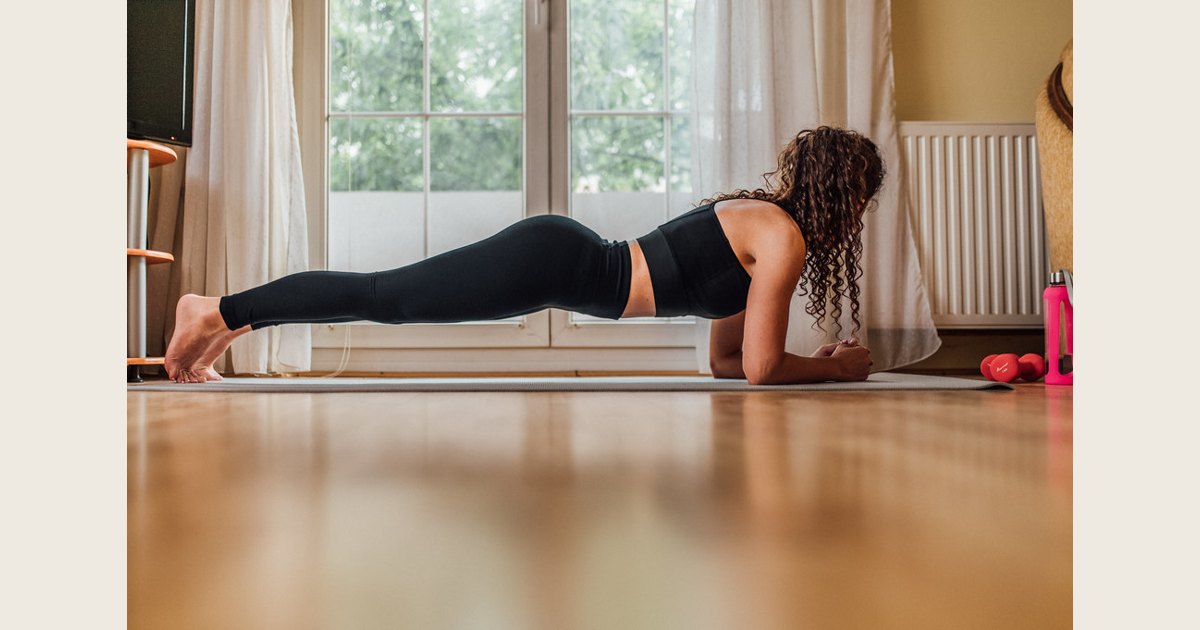
In plank-based practice, a mat needs to stay settled on the floor as well as feel secure beneath hands and feet.
Photo: Fit woman doing a plank on yoga mat by Ivan Radic, Flickr; CC BY 2.0. Resized and padded. Illustrative stock photo; no product testing is implied.
Construction, cushioning, and portability matter as much as the cork
Do not assume a cork yoga mat is a solid piece of cork. Start with the product’s materials list and identify both the top surface and the backing. One example: Yoloha says its Original combines an extra-thick cork surface with a plant-foam bottom made from sugarcane, and describes the finished mat as 51% USDA-certified bio-based renewable materials. The same page lists 6 mm thickness, 2.8 lb weight, and a 5.5-inch rolled size. Those are useful comparison points, not category-wide specifications.
That distinction changes the shopping decision. A cork surface can be what you touch, while the lower layer affects floor grip, cushioning, total weight, and how easily the mat rolls or lies flat. If a listing says only “cork,” look for the detailed material breakdown before buying.
To compare sellers fairly, request the same written specification details from each one: the top surface, backing and any core layers; thickness, weight, and rolled dimensions; dry and damp grip guidance; approved care, drying, and storage restrictions; plus warranty and return terms. If a seller cannot provide a detail, treat that as a comparison gap rather than assuming another model’s claim applies.
Use these questions when comparing models:
| Check | Why it matters |
|---|---|
| What is the backing made from? | It helps explain the complete build rather than just the top surface. |
| What are the listed thickness, weight, and rolled dimensions? | These details help you weigh cushioning against carrying convenience. |
| Does the maker state how the mat behaves on hard flooring? | Floor stability is separate from hand-and-foot traction. |
| Is a warranty or return policy stated? | It gives you a route to assess the mat in your actual practice. |
| Are materials, dyes, and adhesives identified? | A clear specification is more useful than a broad “eco” label. |
Durability: look for clear policies, not a promised lifespan
There is no responsible universal number of years to promise for a cork yoga mat. Wear depends on the exact build, frequency of use, storage, cleaning method, floor type, and how the mat is transported. Rather than rely on a vague durability claim, check whether the seller identifies the surface and backing, gives care directions, and explains what its warranty or return policy covers.
Inspect a new mat before use and keep an eye on edges, seams, peeling, or a backing that no longer stays put. If a defect appears, document it and contact the manufacturer before using an unapproved repair or cleaning method. That is more useful than assuming that a cork surface alone predicts durability.
Care without accidentally shortening the mat’s life
Cork-mat care should be model-led. The verified instructions for Yoloha’s Original say to lightly spray it after use with Yoloha mat cleaner or a natural cleaner, then lay it flat to dry. That is specific to that product; it is not evidence that every cork-and-backing combination should be cleaned the same way. See Yoloha’s care guide on the product page.
Before cleaning any cork yoga mat, check the label or manufacturer page for four points:
- approved cleaner or ingredients;
- whether to spray the mat directly or wipe with a cloth;
- drying position and time; and
- whether soaking, machine washing, heat, or prolonged sun exposure is prohibited.
If you cannot find those instructions, ask the seller before experimenting. A general yoga mat cleaning guide can help frame the questions, but the directions for your specific construction should take priority. Roll and store the mat only when it is completely dry if the maker instructs you to do so; trapping moisture in a rolled mat is not a sensible workaround for a care question.
What “sustainable cork” does—and does not—tell you
Cork has a meaningful raw-material story: it is the bark of the cork oak. Corticeira Amorim says a cork oak can be harvested around 17 times during an average 200-year life. Its cork overview provides that context. This is useful when comparing a cork surface with an entirely synthetic surface.
But it is not a complete environmental verdict on a finished yoga mat. The mat may use a separate backing, foam, adhesives, pigments, shipping materials, and packaging. Manufacturing location, verified material content, durability, repair options, and local disposal or recycling rules also matter. A careful claim is better than an absolute one: cork may be a positive part of a product’s material story, while the full product still requires comparison.
A final pre-purchase checklist
Before choosing a cork yoga mat, confirm that you can answer all of these:
- Grip: Does the maker describe dry and damp use separately, and can you test it during the return period?
- Construction: What exactly is on top, underneath, and between the layers?
- Comfort: Is the listed thickness suitable for your knees, wrists, balance work, and usual floor? If cushioning is the main concern, compare that tradeoff with our thick yoga mat buying guide.
- Portability: Can you comfortably carry its stated weight and rolled size where you practice?
- Care: Are the approved cleaner, drying method, and storage instructions easy for you to follow?
- Policies: Is the warranty or return policy clear enough to evaluate the mat at home or in class?
- Sustainability: Are the specific material claims documented, rather than implied by “cork” alone?
A cork yoga mat is worth considering when its complete build matches your practice—not simply because cork sounds natural or because one brand advertises strong wet grip. Choose a model with transparent specifications, treat its care instructions as product-specific, and use the return period to see whether the surface works for your own dry and sweaty sessions.