Two manufacturer listings provide examples of mats 68 to 74 inches long and 24 to 26 inches wide, as well as longer or wider options. Start there, but check the exact product rather than assuming there is one universal standard: the Jade Harmony comes in 68- and 74-inch lengths at 24 inches wide, while the Manduka PRO is offered in 68-, 71-, and 85-inch lengths at 26 inches wide. Both brands also show that extra-long and wider options exist. JadeYoga’s specifications and Manduka’s specifications are useful examples of the range.
For a comfortable fit, lie down on the mat in the position that uses the most length—often savasana—with your legs long. You want your head and heels to stay on the mat without having to curl up or precisely position yourself. Add a little practical margin for shifting, transitions, and a towel at the top or bottom. A longer mat is usually worth considering when your feet or head routinely reach the ends; a wider mat helps when your hands, forearms, knees, or feet feel crowded from side to side.
Key takeaways
- A 68- to 74-inch-long mat is a sensible place to begin, not a rule that fits every body or practice.
- Width matters separately from length. A 24-inch mat is common in the examples above, while 26- and 28-inch choices provide more side-to-side room.
- Test your longest resting position and your widest stance before deciding. Your usable practice area matters more than a height-based shortcut.
- Extra length and width take more floor, closet, and bag space; compare the rolled and unrolled dimensions before buying.
- Thickness is a separate decision. Our thick yoga mat guide covers its cushioning, stability, and portability tradeoffs; it does not change how much room you have for your body.
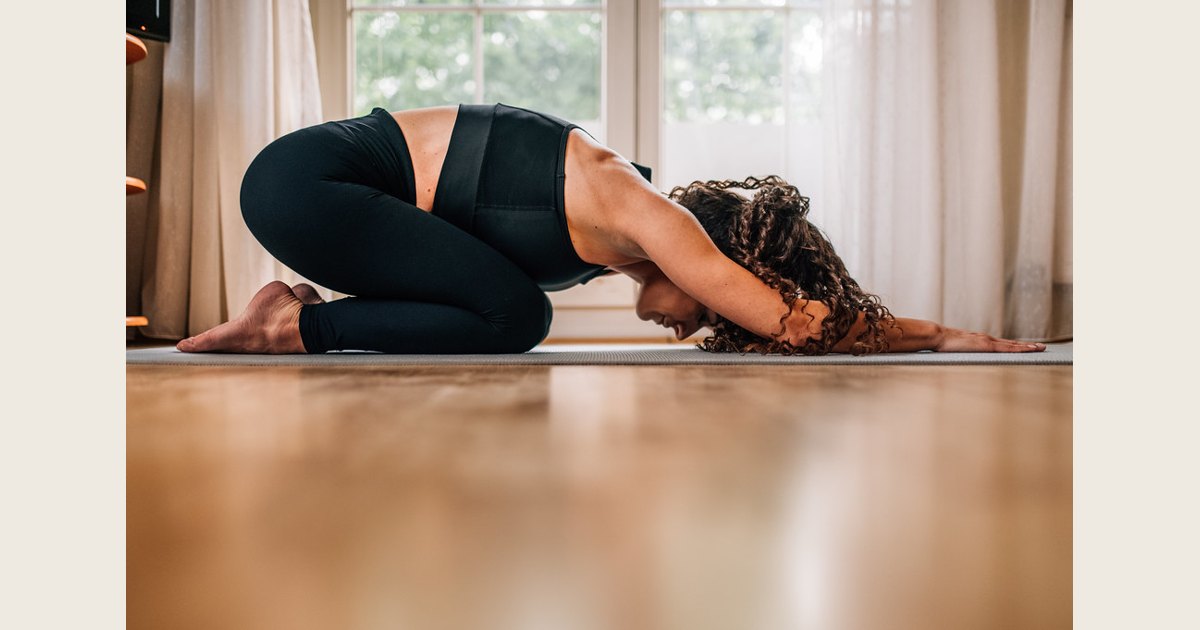
Featured image credit: Photo: Extended puppy pose on yoga mat. A young woman stretching by Ivan Radic, licensed under CC BY 2.0. Resized and padded. Illustrative stock photo; no product testing is implied.
What counts as a standard yoga-mat size?
“Standard” is a useful shopping shorthand, but it is not a promise that every mat will measure the same. Current product listings make the variation clear:
| Example product | Listed length choices | Listed width | What it shows |
|---|---|---|---|
| Jade Harmony | 68 or 74 inches | 24 inches | Two common lengths can share the same narrow footprint. |
| Manduka PRO | 68, 71, or 85 inches | 26 inches | A regular-looking mat may have several length options, including an extra-long version. |
| Jade Harmony XW/XL option | 80 inches | 28 inches | Extra room can add both length and width, rather than solving only one dimension. |
These are product examples, not a definition of what you must use. The useful lesson is to read the dimensions line on the specific listing. A mat called “long,” “large,” or “extra-wide” can mean different measurements from one brand to another.
The 68-inch option is 5 feet 8 inches long; 71 inches is 5 feet 11 inches; 74 inches is 6 feet 2 inches; 80 inches is 6 feet 8 inches; and 85 inches is 7 feet 1 inch. Those conversions can help you visualize a product, but they are not a recommended height cutoff. Arm reach, preferred resting position, and how much buffer you like can make two people of similar height prefer different sizes.
Choose length by checking your real practice position
A yoga mat does not need to contain every bit of motion in every pose. In a long lunge, plank, or Downward Dog, hands and feet may naturally move close to opposite ends. The practical question is whether you can set up and move without constantly guarding the edge.
Use this simple fit check before ordering a new mat:
- Mark out the candidate length. Use a tape measure, painter’s tape, towels, or a blanket on the floor to outline 68, 71, 74, or 80 inches.
- Lie down long. Rest on your back with your arms where you normally place them. Note whether your head and heels have clear space inside the outline.
- Try your transition space. Move from a kneeling position to a plank-like position, then step one foot forward into a lunge. You are looking for repeated end-of-mat crowding, not perfection in a single pose.
- Allow for your setup. If you routinely place a towel, strap, or water bottle at one end, leave the needed floor space outside the mat rather than forcing it onto your practice area.
- Check the room, too. Add walking room around the outline so you can get into the space without climbing over furniture or a wall.
If the 68-inch outline already feels easy in your longest resting position and transitions, more length may not improve the experience. If you repeatedly land at an edge, move to the next available length rather than assuming that a thicker mat will solve it.
Quick check: Do your heels or the back of your head reach the edge when you relax? Mark the next listed length on the floor and repeat the test. If the extra outline gives you a more natural resting position and transition space, that is a practical reason to size up.
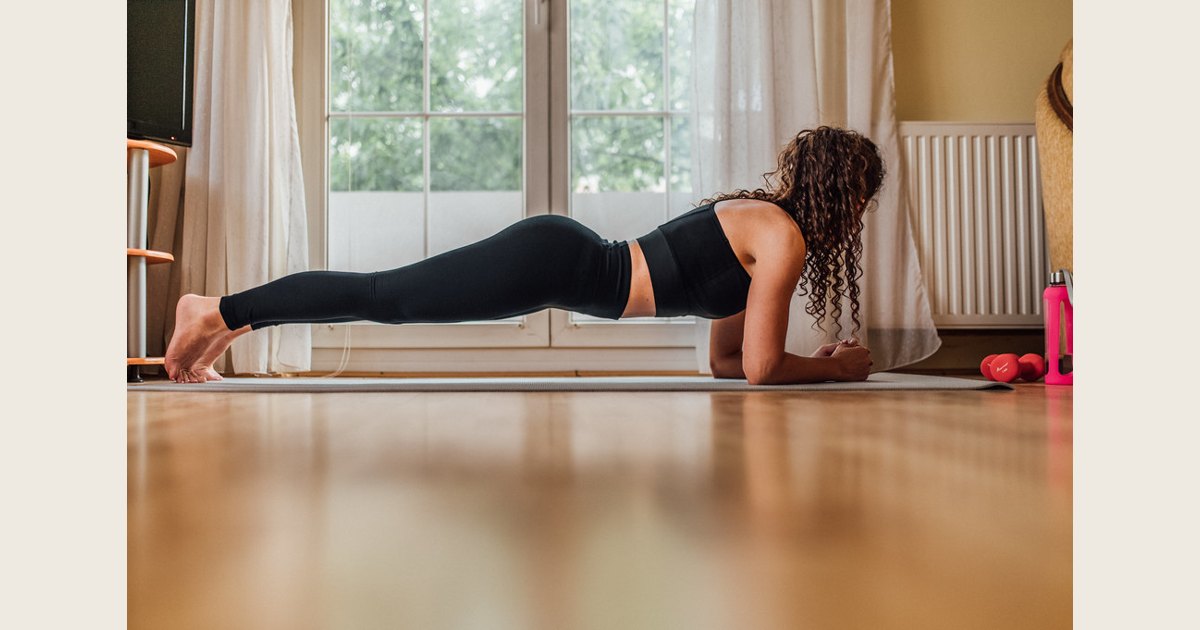
A plank is one transition to try when checking whether your hands and feet fit comfortably on the mat; check your longest resting position separately, too.
Photo: Fit woman doing a plank on yoga mat by Ivan Radic, licensed under CC BY 2.0. Resized and padded. Illustrative stock photo; no product testing is implied.
When an extra-long mat makes sense
An extra-long mat is a fit choice, not a status upgrade. Consider one when your head or heels hang off a regular length in savasana, when your practice has frequent long-body transitions, or when you simply prefer an unhurried buffer at both ends. The Manduka PRO’s listed jump from 71 to 85 inches shows how substantial that difference can be: 14 additional inches is more than a foot of floor length. Manduka lists those dimensions by size.
The tradeoff is straightforward: more mat needs more room. Measure the practice area with the mat fully flat, not only the spot where a rolled mat will live. A long mat can extend into a doorway or reduce clearance near a wall even when its extra size sounds modest on a product page.
Also consider transport. If you walk, bike, or take public transit to class, an 85-inch mat can be less convenient to carry and fit into a bag than a conventional length. That does not make it a bad choice; it means home use and studio travel can lead to different answers.
Do you need a wider yoga mat?
Width helps with a different problem. Choose a wider mat when a normal hand placement in plank, a comfortable kneeling setup, or a wide-footed standing pose leaves you feeling constrained at the sides. It can also be appealing if you use the mat for mobility work that involves lying with arms open or moving laterally.
The manufacturer examples here span 24 inches on the Jade Harmony, 26 inches on the Manduka PRO, and 28 inches on Jade’s XW/XL option. Jade’s page identifies the XW/XL as 28 by 80 inches; Manduka lists its PRO at 26 inches wide. Two or four extra inches may sound minor, but it adds usable space across the full length of the mat.
Before choosing width, tape out both dimensions—not just the length. A 28-inch-wide mat may work beautifully in an open room yet block a closet door or overlap another person’s space in a tightly packed class. If your current mat feels fine side-to-side and only too short, prioritize length first.
Length, width, and thickness solve different problems
It is easy to bundle all three measurements together, but each answers a different question:
- Length: Do your head and heels fit with a useful end-to-end buffer?
- Width: Can you place hands, knees, feet, and arms without feeling boxed in?
- Thickness: How much cushioning and floor feedback do you want?
A thicker mat can change comfort under knees or wrists, but it does not create more length or width. Conversely, an extra-long mat may still feel too narrow in side-to-side work. If cushioning is the concern, see our thick yoga mat guide for the tradeoffs between padding, stability, and portability.
Plan for storage and care before sizing up
Measure where the mat will be used first, then where it will be stored. For a quick room check, write down the mat’s full length and width and add a small perimeter for entering, changing positions, and keeping equipment off the mat. If a room doubles as an office or bedroom, try the taped outline with the furniture in its normal position.
Rolled size is not determined by length alone—material and thickness matter—but a longer mat may be awkward in a short shelf, locker, or mat bag. Look for the brand’s storage guidance after you pick a model. For example, Manduka tells PRO owners to roll the mat with the top facing out and store it in a cool, dry place; that is product-specific advice, so follow the instructions for the mat you actually own. Manduka’s care instructions also say to wipe the mat dry before rolling or using it.
When cleaning is part of the decision, check the material-specific directions rather than treating all mats alike. Our guide to cleaning a yoga mat explains why the safest method depends on the mat material.
A simple way to decide
Start with the size that fits your floor and test it honestly. If you have clear head-and-heel room, enough width for your common positions, and a manageable storage plan, there is no need to chase the largest mat available. If one dimension repeatedly gets in the way, solve that dimension: go longer for end-to-end fit, wider for side-to-side space, and thicker only when you want a different cushion and stability balance.
That approach is more useful than choosing by a single “standard” size or by height alone—and it keeps your mat suited to the way and the place you actually practice.