Affordable adjustable dumbbells can be a sensible home-gym purchase when the tradeoffs match the exercises you actually plan to do. Put the decision in this order: choose a weight range that gives you room to progress, make sure the adjustment and locking process is clear and repeatable, then compare handle fit, storage needs, warranty terms, and total delivered cost. A low starting price is not a bargain if the set feels awkward for your routine or if replacement support is unclear.
The goal is not to find one “best” budget set. It is to identify the compromises you can live with—and the ones you should pass on.
Key takeaways
- Start with your planned movements, not the biggest number on the product page. A set should cover the light end and leave useful room above your current working weights.
- A slower adjustment system can be an acceptable budget compromise. An unclear lock, damaged threads, missing parts, or instructions you cannot follow is not.
- Compare the usable footprint: dumbbells, cradle or tray, plate storage, and the space needed to change settings safely.
- Read the warranty before paying. The FTC advises comparing coverage, exclusions, remedies, claim process, and possible shipping or labor costs—not merely the headline warranty length. FTC warranty guidance
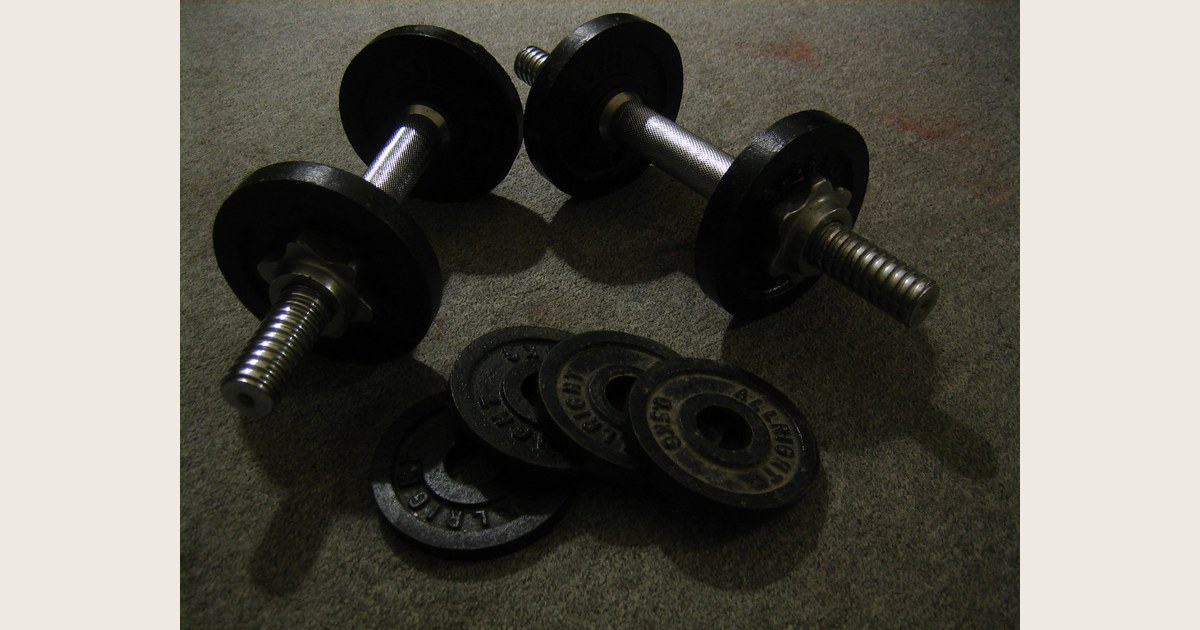
Photo: Dumbbells – Hanteln by qubodup, https://www.flickr.com/photos/21051491@N02/3211594364; https://creativecommons.org/licenses/by/2.0/. Resized and padded. Illustrative plate-loaded dumbbells and loose plates; no product testing is implied.
First, define what “enough weight” means for you
Do not shop by maximum weight alone. Write down the movements you expect to use most often—such as presses, rows, squats, lunges, curls, or floor work—and the approximate load you can control for each. Then assess a candidate set in three places:
- The low end. Can you make small enough changes for shoulder work, raises, warm-ups, or a new movement?
- The middle. Are there usable increments around the weights you expect to reach for most often?
- The top end. Is there headroom for your stronger movements, or will you outgrow the set quickly?
One pair does not have to cover every possible exercise forever. It does need a believable role. A lighter range may suit someone building a compact starter setup; a higher range may be more useful for rows and lower-body work but less convenient when very light increments matter. If you need a specific progression pattern, read the actual settings list rather than assuming evenly spaced jumps.
This is also a good point to separate an equipment decision from a training promise. The federal Physical Activity Guidelines are evidence-based guidance to help Americans maintain or improve health through physical activity. HHS Physical Activity Guidelines A dumbbell set is only one possible tool for that work; choose one that lets you perform your planned exercises with control.
Compare the mechanism before you compare the marketing
“Adjustable” can describe very different systems. The familiar categories below are useful for comparing day-to-day tradeoffs, but a specific product’s instructions always take priority. For a fuller walkthrough of the basic designs, see how adjustable dumbbells work.
| Mechanism | Usually makes sense when | Acceptable compromise | Reason to skip it |
|---|---|---|---|
| Spin-lock handle with loose plates | You value simple, visible hardware and do not mind manual changes | Changing both sides takes time; plates and collars need storage | Threads, collars, or plates are damaged, mismatched, or cannot be secured as directed |
| Selector pin or selector bar | You want multiple settings without handling every plate | The shape can be bulkier than fixed dumbbells | The selector’s position is hard to confirm or the instructions and replacement parts are unavailable |
| Dial-and-cradle system | You expect frequent changes within a workout and want a tidy home base | You must use the supplied cradle and follow the setting sequence | It does not consistently sit in the cradle, settings are unclear, or key parts feel compromised |
A less expensive system is not automatically less safe. The question is whether you can positively confirm that it is configured according to its manual every time you use it. Budget designs often save money through simpler hardware, fewer increments, slower changes, less compact storage, or a lower maximum load. Those may be perfectly reasonable compromises.
What is harder to justify is uncertainty: a selector that will not clearly engage, a collar that does not tighten as intended, parts that do not match the listing, or a seller that cannot provide setup instructions. Do not improvise around missing or damaged locking parts. Pause use and contact the seller or manufacturer for the correct instructions or replacement component.
What to check before buying
Use the product page, manual, and warranty as a three-part checklist. If a retailer listing conflicts with the maker’s documentation, ask for clarification before ordering.
1. Settings, increments, and stated limits
Look for a complete list of selectable weights, whether the listed number is per dumbbell or for the pair, and any stated maximum. Check whether the increments work for your exercises. A wide jump can be fine for a row but frustrating for a light pressing or isolation movement.
Also look for limits on how the equipment may be used. Those could include the intended environment, storage instructions, or actions the manufacturer prohibits. Product-specific safety directions are not interchangeable from one design to another.
2. The real footprint
Measure the floor space where the set will live, then account for more than the dumbbells themselves:
- the tray or cradle, if one is required;
- loose plates and collars for a spin-lock set;
- room to lift the handles straight out and return them without knocking into furniture; and
- a stable, level spot that is not a walking path.
A compact-looking selector set still needs clearance to change settings and rerack carefully. A loose-plate set may occupy more space when fully laid out, even if each handle is short. Think about the transition between exercises, not just the storage photo.
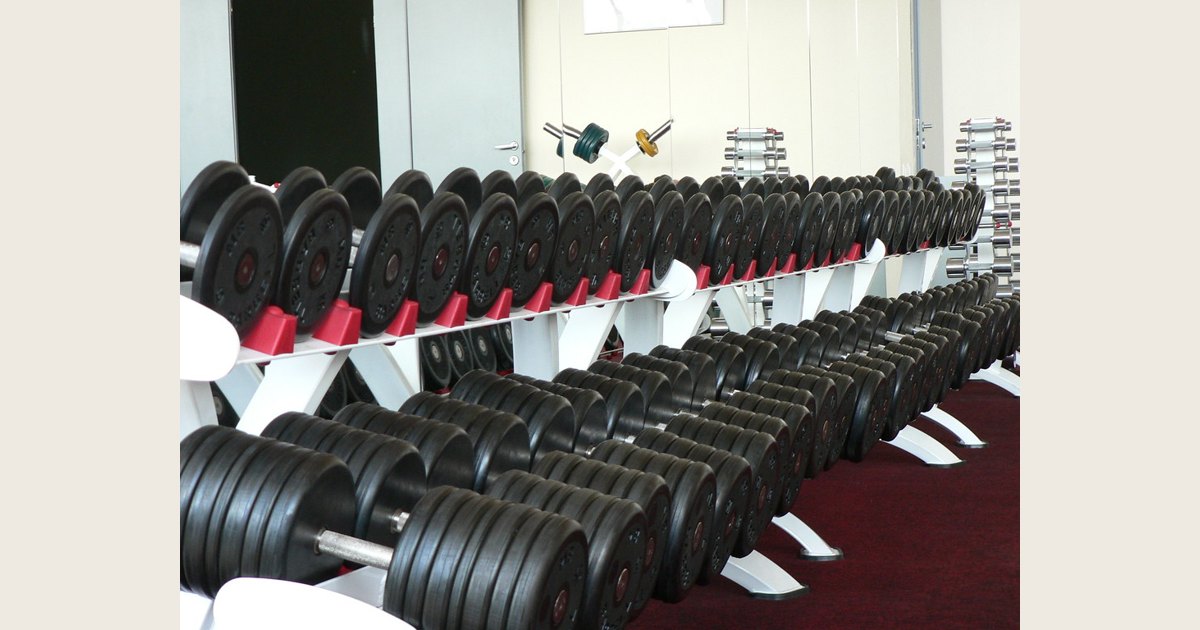
These fixed-weight dumbbell racks illustrate the storage contrast with an adjustable pair, not an adjustable mechanism. Photo: dumbbells by o0bsessed, https://www.flickr.com/photos/25330908@N05/2393321524; https://creativecommons.org/licenses/by/2.0/. Resized and padded. Illustrative stock photo; no product testing is implied.
3. Handle and dumbbell shape
Do not treat “dumbbell” as a standardized feel. Compare the listed handle length and diameter when available, then consider the overall length at heavier settings. A longer or bulkier end can change where the dumbbell rests during presses, rows, goblet-style holds, or movements near your torso.
If you can examine a display model, use that only to assess basic fit and setting clarity—not as proof of durability or performance. Hold it with the kind of grip you expect to use and note whether the handle, ends, and adjustment controls leave enough room for your hands. If you cannot handle it first, buy from a seller with a return policy you understand.
4. Documentation, warranty, and support
Before purchase, locate the manual, assembly or setup directions, warranty, and contact route for replacement parts. A warranty must be available to read before you buy, according to the FTC. Its consumer guidance recommends comparing who stands behind the product, length of coverage, exclusions, what remedy is offered, and whether labor or shipping may be your responsibility. Read the FTC’s warranty checklist.
For affordable adjustable dumbbells, support can matter as much as the warranty duration. A clear answer about a lost collar, damaged tray, or selector component may be more useful than a long label with broad exclusions. Save the receipt, listing, warranty, and manual after buying; the FTC specifically advises retaining the receipt and warranty records. FTC warranty guidance
A practical setup and use check
Follow the manual for your exact set rather than applying a generic ritual. Before a first workout—and after moving, cleaning, or changing any component—use a short check that stays within the manufacturer’s directions:
- Read the adjustment sequence. Know which parts must be aligned, tightened, inserted, or seated before lifting.
- Set the intended weight deliberately. For a selector model, verify the indicator and seating position. For a plate-loaded model, use the specified plates and securing hardware.
- Inspect what you can see. Look for loose, bent, cracked, excessively worn, or mismatched components. Do not use a set with a questionable critical part.
- Lift and rerack with control. Do not assume that a cradle or tray is designed to absorb a dropped dumbbell; follow the product’s stated handling directions.
- Stop when something changes. Rattling, incomplete engagement, a collar that will not stay secured, or a change in fit is a reason to stop and check the manual or contact support—not a reason to test it under more load.
This is intentionally conservative advice, not a substitute for product instructions or professional guidance. People returning to activity, managing an injury, or living with a condition that affects safe exercise should seek individualized advice. The World Health Organization notes that its guidelines address people across ages as well as people with chronic conditions and disabilities. WHO physical-activity fact sheet
Reasonable budget compromises—and deal breakers
Here is a useful final filter.
Usually reasonable, if documented and functional:
- a slower plate-change process;
- fewer settings or larger jumps;
- a lower top weight that still fits your planned use;
- loose plates that require dedicated storage; and
- a simpler finish or less polished storage solution.
Pause or skip until resolved:
- no clear explanation of how the load locks or stays secured;
- missing manual, contradictory specifications, or no settings chart;
- visible damage, stripped threads, cracked plates, loose handles, or unstable tray components;
- a pair sold without the hardware the instructions require;
- warranty terms that cannot be found before purchase; or
- a return policy that does not fit the cost and difficulty of returning heavy equipment.
The last point is not about finding a perfect policy. It is about knowing the practical consequence of a poor fit before boxes arrive.
The bottom line
The right affordable adjustable dumbbells are the pair you can set up correctly, lift with control, store safely, and use often—not the pair with the boldest maximum-weight claim. Choose a clear, documented locking system first; match the weight range and increments to your exercises; and read the warranty and return terms before paying.